Gospel according to Saint Matthew 17:1-9
Jesus took Peter, James, and John his brother, and led them up a high mountain by themselves. And he was transfigured before them; his face shone like the sun and his clothes became white as light. And behold, Moses and Elijah appeared to them, conversing with him. Then Peter said to Jesus in reply, “Lord, it is good that we are here. If you wish, I will make three tents here, one for you, one for Moses, and one for Elijah.” While he was still speaking, behold, a bright cloud cast a shadow over them, then from the cloud came a voice that said, “This is my beloved Son, with whom I am well pleased; listen to him.” When the disciples heard this, they fell prostrate and were very much afraid. But Jesus came and touched them, saying, “Rise, and do not be afraid.” And when the disciples raised their eyes, they saw no one else but Jesus alone.
As they were coming down from the mountain, Jesus charged them, “Do not tell the vision to anyone until the Son of Man has been raised from the dead.”
He touched them and said, “Do not be afraid.”
Luis CASASUS President of the Idente Missionaries
Rome, March 01, 2026 | Second Sunday of Lent
Gen 12,1-4a; 2Tim 1,8b-10; Mt 17,1-9
Although the scene of the Transfiguration seems unique and spectacular to us—and indeed it is—we resemble Peter, James, and John in their reaction on that mountain: in a few moments, they went from the deepest joy to the most unbearable fear and confusion.
It was one of those rare moments that each of us keeps in our hearts to return to in the most delicate situations, in times of doubt or pain. Moses and Elijah, accompanying the Master, represented for the Israelites all the authority of the Law and the Prophets; the voice of the Father, inviting them to listen to Jesus and, above all, that hand of Christ on the disciples’ shoulders, saying to them, “Do not be afraid,” was what enabled them to continue walking, as Jesus asked them to, “until the Son of Man has risen from the dead.”
We do not need to climb a mountain, but when we look back, each of us sees some of those episodes in our lives as a mountain that rises powerfully above experiences that we may now find difficult to overcome and understand.
What is characteristic of these episodes?
* They are not “rewards” or coincidences. They are part of the divine plan for each of us, and it is easy to get caught up in the emotion of the moment and the nostalgia of the time when it happened.
* They are intimate and personal. They may occur alongside others and be very meaningful to them as well, but they carry a personal message for those who experience them, leaving a mark that lasts a lifetime. They may contain some element of light about the kingdom of heaven or the Gospel message, but above all, their power lies in the confirmation of having been forgiven and called to the mission. Our Founder, Fernando Rielo, when he was only 16 years old and, as he tells us, could not understand many truths, felt deeply the call of God when he helped a child who fainted during a camp march.
The image of Christ that we perceive then is that of someone who places all his trust in us. What an impression Peter, James, and John must have had from the moment Christ took them aside to a mountain! It was so powerful that the mark left by that call would overcome all the feelings of fear, pride, and envy that would later assail them “in the valley.” Authentic preventive medicine…
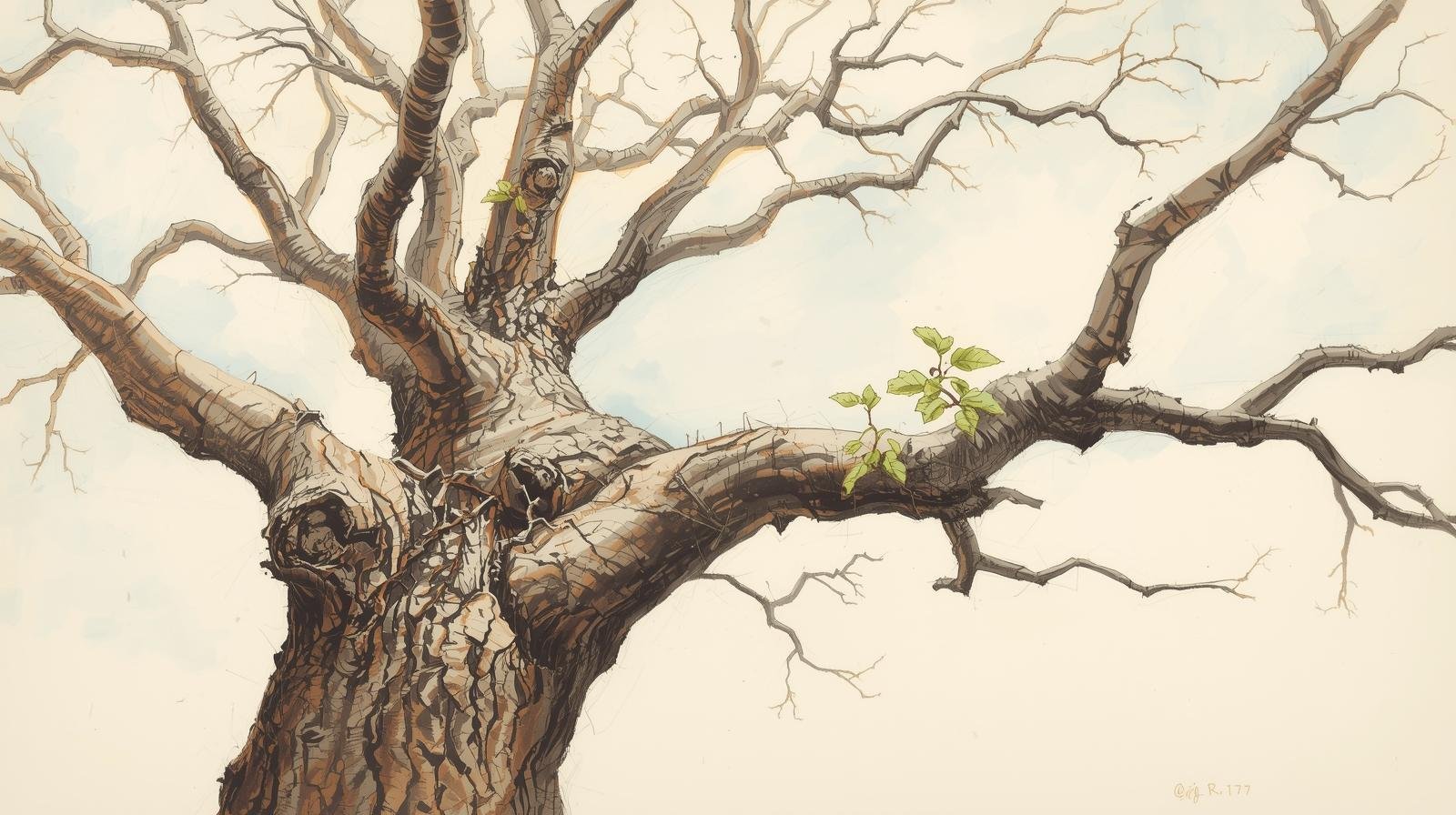
Even people who are not interested in a relationship with God treasure moments that will always light their way. Others, sensitive to the spiritual life but finding it difficult to integrate into the Church, have been able to draw on the most beautiful experiences of the past to continue on their journey. This is the case of the Spanish poet Antonio Machado (1875-1939): in his famous poem “To a Dry Elm Tree” (1912), he contemplates an old and almost dead tree, a symbol of wear and tear, pain, and illness. He wrote it while his wife was seriously ill, on the verge of death. However, upon discovering that green leaves have sprouted on the tree, a spark of hope emerges:
To the old elm tree, split by lightning
and half rotten,
with the April rains and the May sun,
some new leaves have sprouted
(…)
My heart also waits
for the light and for life,
another miracle of spring.
The dry tree represents illness and the proximity of loss, but those new leaves symbolize the certainty of being able to be reborn, even when all seems lost. The poem does not deny suffering; it fully acknowledges it. But even so, the poet maintains hope in a “miracle,” in a renewal that is always possible, based on the happy experience lived long ago.
* Those experiences that Providence grants us are always to be shared with our neighbors. First, because they confirm us as instruments of His kingdom; second, because surely those around us need to remember moments they have experienced that will help them overcome states of pain and helplessness.
This was the case with Moses, when he received the Commandments on Mount Sinai, and likewise with Elijah, who, desperate and hiding on Mount Horeb, received Yahweh’s forgiveness and trust to guide his people. Surely one of the most significant examples is the moment when Jesus forgives Peter after he denied the Master and entrusts him with a unique mission. And a spectacular case, which does not necessarily resemble our experience, is that of St. Paul in Damascus, where he received a mission in an unpredictable way and with signs that left no room for doubt: his fall from a horse, his blindness, the help of those he was persecuting.
—ooOoo—
Christ’s refusal to allow the disciples to build three tents is a way of making them understand that their lives and ours are short and—as Pope Francis said—we must be a Church and a community that is always “going forth,” identical, aware that we must live each day with a new purpose of drawing closer to Christ and our neighbor. This is always the essential content of the divine plan we spoke of earlier.
Our tendency to “build tents” is very strong. It manifests itself in laziness when facing the challenges that continually arise in dealing with people. We try to keep everything the same as in the “good old days” and do not easily accept that people change and that every relationship needs new forms of expression. By not doing so, by not accepting the changes that Providence presents to us, we become frustrated when we see demands, tensions, or differences arise in those around us.
A beautiful example contrary to this rigidity was the attitude of Mary and Joseph when they saw their son beginning his adolescent apostolate and an increasingly visible dedication to “the things of the Father.”
The detail in the Gospel that the Master touched the three disciples to tell them not to be afraid is important, for it reminds us that he approaches us with tenderness and humanity; he conveys security to us with the mere impression of his presence. Fear paralyzes, but that touch of Christ restores confidence and the ability to stand up.
This is not magic; the memory of Christ as someone who historically preceded us, the awareness that he has helped me before, and the knowledge of how many people have been able to take advantage of that touch, confirm to me that he will never leave me alone.
His closeness is telling me:
* I know your suffering. Moreover, as a man, I have also suffered; in that we are alike.
* Even in your situation of fear and confusion, I need you to walk together in the mission I am showing you.
In the Living Flame of Love, St. John speaks of the “touch” as a sudden irruption of grace in the soul:
Oh, gentle cautery!
Oh, welcome wound!
Oh, soft hand! Oh, delicate touch,
which tastes of eternal life
and pays all debts!
It is a poetic and accurate way of expressing that Christ’s consolation does NOT provide us with the relief that my human nature demands: I would like to see the future clearly, to feel that I am capable and that I am unconditionally supported by those around me. It is not exactly like that; our wound does not close, but the “cautery” (healing of a wound) is to verify that my pain is fruitful, that it is always used by Providence as a humble element in divine plans.
The experience of Affliction and of Beatitude go hand in hand. Referring to the Transfiguration and Gethsemane, St. Thomas wrote:
Jesus himself chose the same witnesses to see his face transfigured by the glory of God and disfigured by the sin of the world (III q. 45).
In reality, if we are at all sensitive, we are like married couples who are on the verge of separating because of some crisis: remembering the good times they spent together gives them the courage to continue working for what once united them.
Right after the Transfiguration, St. Luke recounts how, immediately after Jesus came down from the mountain with Peter, James, and John, a man runs up to him and asks for help: My son is possessed by a spirit that seizes him, throws him to the ground, makes him foam at the mouth and scream until he falls exhausted; I have begged your disciples to cast it out, but they have not been able to.
Why were they unable to fulfill their mission if the Master had given them the necessary powers? Because those who have not seen his glorious face are unable to counteract the forces of evil that afflict humanity. Those disciples were not on the mountain with Christ.
Our moments of silent prayer and reflection on the Gospel are privileged occasions to become more aware of how he has touched our shoulder in situations where our own sin and difficulties with our neighbors push us to abandon the path. We cannot be his witnesses unless in prayer we “see his face,” the face of Jesus crucified and risen.
In today’s Gospel reading, we find the biblical image of the luminous cloud that envelops everyone. The book of Exodus speaks of a shining cloud that protected the people of Israel in the desert and was a sign of God’s presence with his people on their journey to the Promised Land. When Moses received the law, the mountain was also enveloped in a cloud, and he came down with a shining face. The cloud and the shining face are a reflection of God’s presence, and Christ himself had this experience on Mount Tabor.
Let us not forget, then, that moments of enthusiasm, perhaps when we first feel God’s call, are followed by disagreements with those close to us, or by weariness and disappointment: following the Master does not seem to be what we expected. We need only remember that, even if only once, even if we did not fully understand it… we have seen his face.
_______________________________
In the Sacred Hearts of Jesus, Mary and Joseph,
Luis CASASUS
President