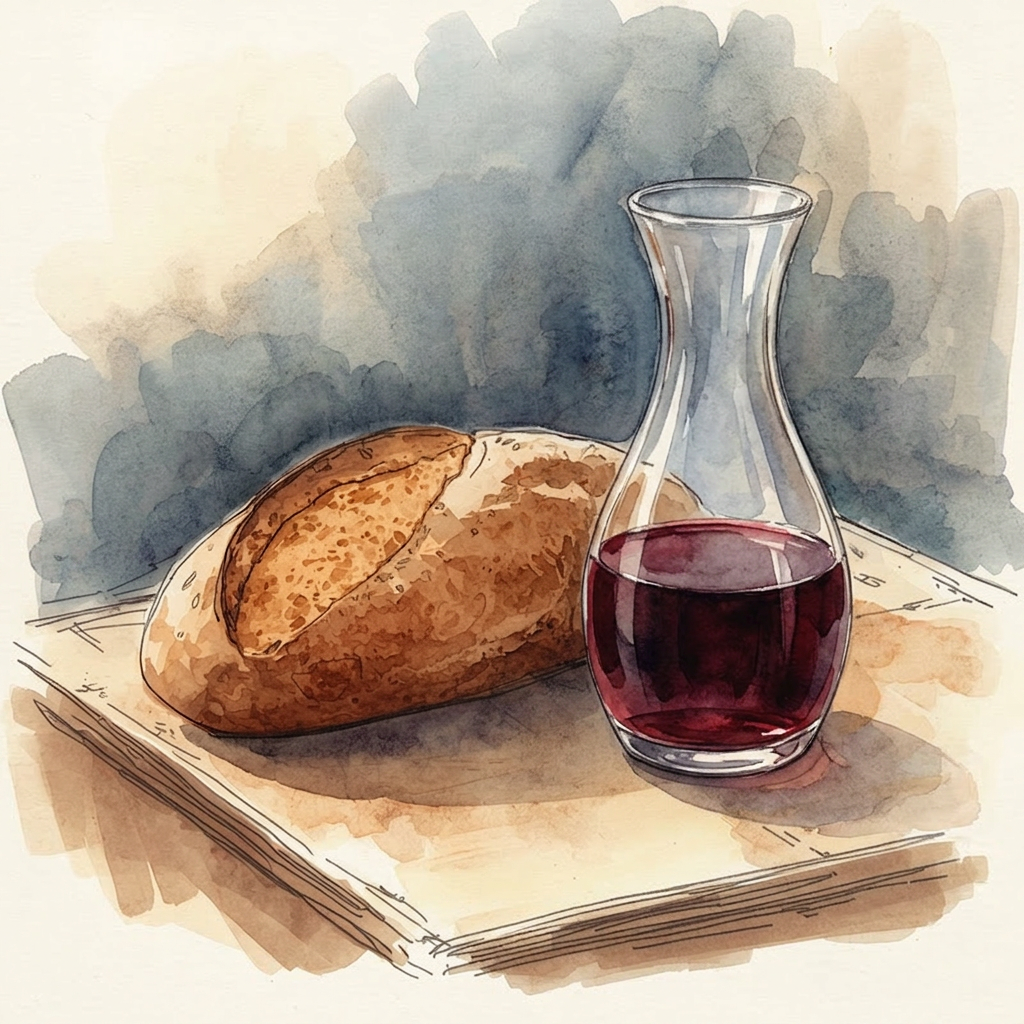
Gospel according to Saint John 6,51-58
Jesus said to the Jewish crowds: “I am the living bread that came down from heaven; whoever eats this bread will live forever; and the bread that I will give is my flesh for the life of the world.”
The Jews quarreled among themselves, saying, “How can this man give us his flesh to eat?” Jesus said to them, “Amen, amen, I say to you, unless you eat the flesh of the Son of Man and drink his blood, you do not have life within you. Whoever eats my flesh and drinks my blood has eternal life, and I will raise him on the last day. For my flesh is true food, and my blood is true drink. Whoever eats my flesh and drinks my blood remains in me and I in him. Just as the living Father sent me and I have life because of the Father, so also the one who feeds on me will have life because of me. This is the bread that came down from heaven. Unlike your ancestors who ate and still died, whoever eats this bread will live forever.”
Bread and Wine, God in Man
Luis CASASUS President of the Idente Missionaries
Rome, June 07, 2026 | The Body and The Blood of Christ
Dt 8, 2-3. 14 b-16 a; 1Cor 10,16-17; Jn 6: 51-58
Many important commitments are sealed with a special meal and a toast. Sitting down together at the table and raising a glass have deep significance and often mark the sealing of a significant agreement. For example, newlyweds and their friends toast to a happy future spent together, and on birthdays we toast to doing everything possible to ensure the happiness of the person celebrating their special day.
In classical Greece and Rome, toasts were made for two main reasons:
* As a sign of trust; this demonstrated that the drink was not poisoned, since clinking glasses forcefully caused the liquid to splash and mix among those present.
* To engage all the senses, as it allowed the sense of hearing to also participate in the joy of drinking wine, joining taste, sight, smell, and touch. There are gestures so important that we wish to put our whole soul and our whole body into them.
Let us recall one of the world’s most famous literary mottos: All for one and one for all. It comes from the novel The Three Musketeers (1844) by the French writer Alexandre Dumas. In the novel, the characters often use this phrase just before a battle or when raising their glasses in a tavern to celebrate their victories. It represents absolute loyalty. If a member of the group faces a problem or an enemy, the whole group will defend them as if it were their own problem.
Of course, the Eucharist is more than a toast, but its meaning is so profound that it also encompasses what toasts signify throughout the world: solidarity among people and commitment to a common cause.
What is that commitment? Of course, it is to live according to the way of Christ, in accordance with the spirit of the Gospel. That is why, when we celebrate Holy Mass, and also when we administer the Anointing of the Sick, there is a prior celebration of the Word, to engrave in our hearts the nature of the covenant we renew with Jesus. That is why Paul’s words are significant:
Let each one examine himself, and then eat of the bread and drink from the cup. For whoever eats and drinks without discerning the Lord’s body eats and drinks judgment upon himself (1 Cor 11:28–29).
The Second Vatican Council highlighted this in one of its key documents:
The Church has always venerated the Sacred Scriptures just as she venerates the Body of the Lord itself, never ceasing to take from the table and distribute to the faithful the bread of life, both the word of God and the Body of Christ, especially in the Sacred Liturgy (Dei Verbum 21).
—ooOoo—
However, there is a great difference between the moment of raising a glass of wine and the elevation of the chalice. In the first case, it is a matter of encouraging one another to put forth our utmost effort to achieve a goal, even if it is vaguely formulated, such as “happiness.” But in the Eucharist, we open ourselves to the power of grace; drinking from the cup is accepting his covenant, letting his life enter into ours. Of course, the very act of approaching the altar to receive the Body and Blood of Christ is a silent confession of our own weakness, of the hunger and thirst for God that we suffer, even if we cannot always grasp its depth.
I remember clearly and with emotion the case of a young Dutch man who participated in our Way of St. James. He didn’t even remember if he had been baptized, nor whether he was Protestant or Catholic; such was the extent of his lack of religious and spiritual formation. At the end of our pilgrimage, on the feast of St. James the Apostle, our pilgrim group participated in the solemn Eucharist at the Cathedral, presided over by the Archbishop. All the concelebrating priests distributed the Eucharist, and I could see how our young friend approached in another line to receive Christ in the Blessed Sacrament.
After Mass, I asked him if he understood what he had done, and his answer was as sincere as it was forceful: I couldn’t help but participate in that moment. Then we had a brief “emergency” catechesis, facto consummato (after the fact) as they say in legal parlance.
Contemporary sociologists and philosophers agree that we are living in the age of “liquid modernity”. Unlike the rigid thinking of past eras, the contemporary mind is skeptical, fast-paced, and deeply shaped by a naive worship of technology. That is why we are told to understand and embrace Christ’s statement, which we naively confuse with magic or mere pious opinion:
Whoever eats my flesh and drinks my blood remains in me, and I in him.
On the contrary, the experience of the saints shows that this is indeed the case. For example, Saint Teresa of Ávila states that, after receiving the Eucharist, she experienced an absolute certainty of Jesus’ living presence within her, which led her into a state of profound contemplation where she conversed with Him “heart to heart.” Likewise, Saint Ignatius of Loyola: He felt an inner fire and an irresistible impulse of love that did not come from his own strength, but from the “Divine Guest” who dwelt within him.
Today’s First Reading is an invitation to remember how God’s hand has been and is always present in us, not only in the epic history of Israel, which was able to cross the desert and reach the Promised Land. In the consecrated Bread and Wine, beyond the physical and psychological effects, a form of Christ’s presence occurs again and again that is different from His “usual” companionship. St. Paul expressed this perfectly when he said: I no longer live, but Christ lives in me (Gal 2:20). We have—above all—the continuous experience of forgiveness, repeated tirelessly, in which we are called to work in the Father’s Vineyard despite any infidelity.
Manna is the image that announced how true nourishment comes from God, not simply from our efforts and limited ingenuity. In addition to satisfying hunger, it reminded the Israelites—just as the Eucharist reminds us—that we are living in a true exodus toward heavenly life, toward true life, for which every effort and abnegation is worthwhile.
—ooOoo—
During the Last Supper, Jesus performed his supreme act of love—a total gift of life that he would later offer in a different way on the Cross. The Word of God and the Bread of Heaven can be received with both mind and heart through the Sacrament, recalling Christ’s words: Man does not live by bread alone, but by every word that comes from the mouth of God.
Although the Jews understood that eating the Bread of Heaven meant accepting Christ’s teachings—the Gospel—they could not, however, understand what it meant to “eat his own flesh.” So their question: How can this man give us his flesh to eat?, was to be expected. They realized that he was not referring only to the spiritual meaning, but to a concrete, physical act.
Drinking blood is repulsive to the Jews; in fact, when they slaughtered an animal for food, they let it bleed to death, believing that the “life force” is found in the blood. This is the culture and atmosphere in which Christ spoke those words, with the clear intention of showing that this was truly a new covenant.
The Eucharist must be received with faith; otherwise, it would have no effect, because it must be an expression of our inner decision to accept Christ and allow him to fill our entire life: our decisions, actions, speech, and overall behavior. If this sacrament is received with faith, our union with Christ becomes ever more solid and profound.
Drawing wisely on the experience of various churches, St. Paul teaches the Corinthians today that the Eucharist not only brings about a personal union with Jesus, but is also the means of unity among us: Though we are many, we form one body, because we all partake of the same bread.
The Corinthian community was diverse, with Christians who had lived according to very different traditions and lived alongside pagans who performed ceremonies such as offering sacrifices to idols. For this reason, the issue of consuming meat from sacrifices to the gods was a highly debated matter. St. Paul writes not only with “formative” intentions, but to calm the bitter arguments and condemnations that were circulating among them.
To us, this may seem somewhat irrelevant, especially in cultures less sensitive to rites and ceremonies, but today, as in the past, divisions arise in every community even over trivial matters. True unity is achieved not only through the necessary effort to live in humility and forgiveness—which are always essential—but by coming together to the same food, to the same source.
A masterful literary example illustrating how true unity arises from coming together to the same source of nourishment is the novel Babette’s Feast (1958), written by the Danish author Karen Blixen. This work perfectly describes how shared food, prepared as an act of pure self-giving, is capable of healing human divisions and uniting souls.
The plot is set in a small, remote, and austere Puritan community in a coastal village in Norway. The inhabitants live under extreme religious rules, rejecting any earthly pleasure. Over the years, old feuds, jealousy, gossip, and past resentments have fractured their coexistence, transforming the village into a place of cold, isolated, and divided souls.
Babette, a French refugee fleeing the war, is taken in as a cook by two elderly women in the village. After winning the lottery in France, instead of using the money to return to her country, she decides to spend it all on importing the most exquisite ingredients from Paris to prepare a single, opulent dinner in honor of the community’s late pastor.
When the Puritans sit down at the table, they do so with suspicion, determined not to enjoy the meal so as not to fall into the sin of hedonism. However, as the dinner progresses and everyone begins to partake of the same exceptional feast and the same source of love and sacrifice that Babette has prepared, a miracle occurs:
The sublime flavor of the food and wine acts as a grace that disarms their defenses. Tongues, once dry and sharp with bitterness, begin to soften. It is the dissolution of selfishness:
Old enemies who had not looked each other in the eye for decades ask for forgiveness; frustrated loves from the past reconcile with their fate; hardened hearts become tender.
As they all partake of the same offering (for Babette has literally been reduced to poverty by giving them everything she had), the fractured community becomes one body once more. The novel describes the end of the dinner with a beauty that evokes the liturgy of unity:
The villagers left the house transformed. They felt light and clean, as if they had participated in a sacred mystery. They took each other’s hands under the stars and began to sing together the old hymns of their childhood. They were no longer individuals isolated by their grudges; the same source had brought them together again.
It is paradoxical—like so many things from the Master—that he teaches us how breaking bread produces unity. But the broken bread teaches that true unity is born of the capacity to empty oneself and give oneself to others. In the logic of the Kingdom of God, the bread is not broken simply to be divided, but to be multiplied and shared, transforming physical fragmentation into spiritual unity.
_____________________________
In the Sacred Hearts of Jesus, Mary and Joseph,
Luis CASASUS
President