Gospel according to Saint Matthew 13:1-23:
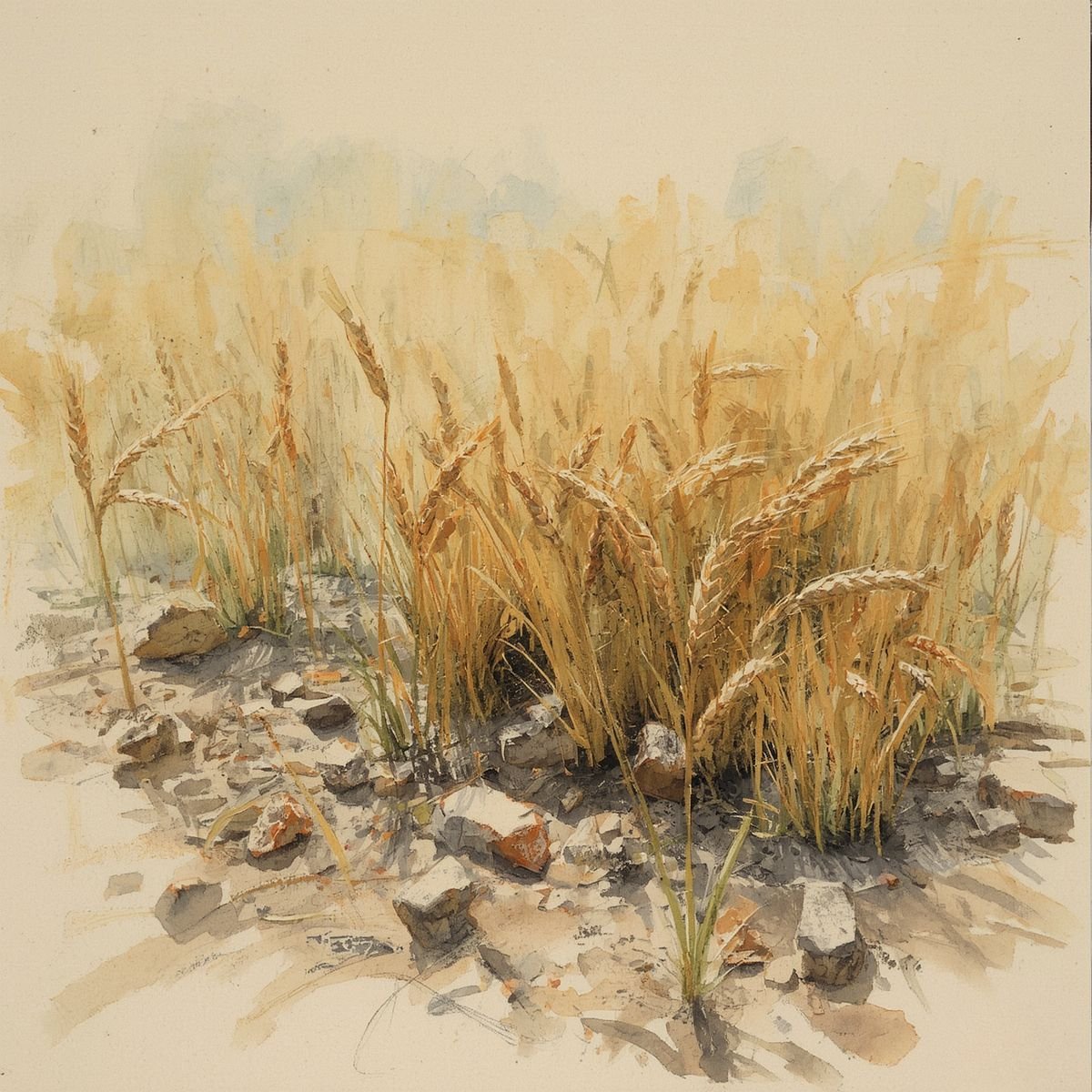
On that day, Jesus went out of the house and sat down by the sea. Such large crowds gathered around him that he got into a boat and sat down, and the whole crowd stood along the shore. And he spoke to them at length in parables, saying: “A sower went out to sow. And as he sowed, some seed fell on the path, and birds came and ate it up. Some fell on rocky ground, where it had little soil. It sprang up at once because the soil was not deep, and when the sun rose it was scorched, and it withered for lack of roots. Some seed fell among thorns, and the thorns grew up and choked it. But some seed fell on rich soil, and produced fruit, a hundred or sixty or thirtyfold. Whoever has ears ought to hear.”
The disciples approached him and said, “Why do you speak to them in parables?” He said to them in reply, “Because knowledge of the mysteries of the kingdom of heaven has been granted to you, but to them it has not been granted. To anyone who has, more will be given and he will grow rich; from anyone who has not, even what he has will be taken away. This is why I speak to them in parables, because they look but do not see and hear but do not listen or understand. Isaiah’s prophecy is fulfilled in them, which says: You shall indeed hear but not understand, you shall indeed look but never see. Gross is the heart of this people, they will hardly hear with their ears, they have closed their eyes, lest they see with their eyes and hear with their ears and understand with their hearts and be converted, and I heal them.
“But blessed are your eyes, because they see, and your ears, because they hear. Amen, I say to you, many prophets and righteous people longed to see what you see but did not see it, and to hear what you hear but did not hear it.
Hear then the parable of the sower. The seed sown on the path is the one who hears the word of the kingdom without understanding it, and the evil one comes and steals away what was sown in his heart. The seed sown on rocky ground is the one who hears the word and receives it at once with joy. But he has no root and lasts only for a time. When some tribulation or persecution comes because of the word, he immediately falls away. The seed sown among thorns is the one who hears the word, but then worldly anxiety and the lure of riches choke the word and it bears no fruit. But the seed sown on rich soil is the one who hears the word and understands it, who indeed bears fruit and yields a hundred or sixty or thirtyfold.
An Uncommon Sower
Luis CASASUS President of the Idente Missionaries
Rome, July 12, 2026 | XV Sunday in Ordinary Time
Is 55: 10-11; Rom 8: 18-23; Mt 13:1-23
The disciples must have been amazed as they listened to Jesus’ parables, especially the one we heard today, which uses the image of the Sower. That is why they asked him why he spoke to the people in parables. In his reply, Christ draws a distinction between his followers and those who listened to him with unbelief or ill will.
A parable is, literally, something that is “placed alongside” something else. Jesus’ parables are stories that were “placed alongside” a truth in order to illustrate that truth. A parable is an earthly story with a heavenly meaning. Christ uses parables primarily to reveal the mysteries of the Kingdom of God to those with a willing heart and, at the same time, to hide the truth from hardened hearts or those who sought only to judge him.
Regarding this “unequal treatment,” here is the interpretation of Theophylact of Bulgaria, a ninth-century author whom St. Thomas Aquinas credits by quoting these words of his: For God gives sight and understanding to those who ask, while He blinds the others, so that they may not end up deserving a greater punishment for understanding and yet refusing to do what they ought.
Whether or not this interpretation is accepted, the parables certainly provoked reflection; rather than simply providing information, they served as a challenge. They required the listener to think for themselves and make a personal decision regarding the message and their own life. This illustrates the unifying meaning and intent of Christ’s teachings, going beyond a purely intellectual or academic dimension.
Furthermore, the parables offered fundamental advantages: As a pedagogical method, they facilitated the understanding of profound spiritual truths by using everyday elements familiar to the people of his time (farming, fishing, weddings). On the other hand, they avoided premature political conflicts, for by using stories and indirect illustrations, the Master conveyed his message without giving his religious and Roman opponents an easy excuse to arrest him immediately for sedition or heresy. The parable—the rabbis said—is like a candle wick: it costs a few cents, and yet, even though its light is dim, it can help one find a treasure.
In the Parable of the Sower, we find a very clear guide so that each of us may discern what our true attitude is toward what He calls the Word of the Kingdom,
In today’s Gospel, the Word of the Kingdom is the Good News about God’s reign and saving presence revealed through Jesus Christ. It is the message that transforms the life of whoever accepts it and puts it into practice. We could say that this concerns our mystical life, everything we receive from the Divine Persons that we do not always perceive or use in the best way.
To begin with, one thing we must keep in mind is that the Sower leaves no part of the ground unseeded. This must have surprised the listeners, since it doesn’t seem like an efficient way to sow. But Jesus isn’t referring to the soil; he isn’t referring to us; he isn’t encouraging us to change the qualities of our soil to receive the seed… Our reaction is sometimes to wonder what kind of soil we are and why we haven’t received the Word. Am I stony ground? Do I have thorns? Am I perhaps as barren as a road?
However, the Parable does not speak only of us; it speaks—above all—of the Sower. It tells us that he sees possibilities even in the least suitable soils; even though he knows there will hardly be any fruit there, he scatters the seed anyway.
This parable tells us that we are loved despite any imperfection. No flaw and no merit will change the mercy we receive from the Sower. If we are sincere, we recognize in ourselves the hardness, the thorns, and the stones. Even if we believe ourselves to be “good soil,” producing 30, 60, or 100 percent… is something technically unimaginable.
Faced with a Sower so full of generosity and dreams, I should recognize that the imperfections of my soul, of my soil, cannot be an obstacle to receiving the Word of the Kingdom, which asks me to “produce” mercy like the mercy I have received.
Certainly, this Parable is a challenge; it demands a response: to use my limited sensitivity to receive what the Spirit asks me to do. Depending on whether that is my attitude, or whether I pay no attention, what Jesus repeats today—referring to Isaiah—will happen to me: To the one who has, more will be given, and he will have an abundance; but from the one who has not, even what he has will be taken away.
This statement, far from being a threat, is advice, because the sensitivity of the human heart can change. By saying, They are hard of hearing and have closed their eyes, so that their eyes do not see, their ears do not hear, and their hearts do not understand, Jesus describes a condition of spiritual hardening, but not a fixed or irreversible condemnation. The Gospel teaches us that human beings are not trapped forever in a certain “kind of “ground.”
To avoid what that verse describes (blindness, spiritual deafness, and the lack of conversion), what is required, first and foremost, is the desire for conversion (in Greek, metanoia, meaning “change of mind”). It all begins when a person recognizes their own insensitivity and decides, of their own free will, to turn toward God, even if not in a radical way.
Metanoia functions as the bridge connecting human effort (the ascetic life) with the experience of divine grace (the mystical life).
► The ascetic life is the realm of effort, self-discipline, and the purification of the senses. Metanoia begins here as an act of the human will, involving a conscious effort to look inward, recognize one’s own insensitivity or deviation, and decide to change course.
Extending the parable of the Sower, this is equivalent to the work of removing stones and pulling out thorns through daily discipline. At its core is abnegation of the ego, the voluntary decision to abandon thought patterns and unnecessary preferences and desires that harden the heart, continually progressing in the Gospel Spirit, in the way of life of Christ.
► On the other hand, the mystical life is a pure gift, an experience of communion where God acts and the human being strives to receive and welcome.
Metanoia does not merely involve changing one’s ideas (intellect), but transforming the way one perceives reality (the heart). By changing this sensibility, the person becomes capable of perceiving what comes from God, above all the call to mercy.
As Matthew 13:15 says, human beings convert (ascesis) themselves, but it is God who heals (the mystical life) them. Metanoia is the state of openness that allows God to infuse His grace.
This metanoia is not a one-time event, but an ongoing state. It unites both worlds because asceticism without metanoia becomes mere moralistic pride (believing that one is saved by one’s own efforts). On the other hand, mysticism without metanoia runs the risk of being an emotional illusion or sentimentality, without any real transformation of life.
In short, asceticism prepares the ground by softening the soil; metanoia is the radical turn that orients that soil toward the sun; and mystical life is the rain of divine grace that causes the seed to sprout.
Note that verse 15 itself ends with an implicit promise: …so that they may not see with their eyes, nor hear with their ears, nor understand with their hearts, and turn, and I may heal them. Human beings cannot change their sensibilities completely on their own. Already in the Old Testament, God promises precisely this transformation:
I will take away the heart of stone from within you and give you a heart of flesh (Ezekiel 36:26).
Patiently reducing material attachment, stress about the future, and the noise of daily life restores the heart’s sensitivity to perceive what is truly spiritual.
We can illustrate the desire for conversion with a contemporary example, not immediately related to religion; it concerns James Fallon (1947–2023), an American neuroscientist who discovered, purely by accident in his own laboratory, that he had the brain of a violent psychopath,
His story demonstrates how a person can force a change in their sensibility through conscious effort (true asceticism) when nature did not naturally endow them with empathy.
Fallon was a successful scientist, married with children. However, he always knew that he was a cold, extremely competitive, manipulative man who lacked any real empathy for the feelings of others.
In 2005, while analyzing brain scans of serial killers in his laboratory, he discovered an image showing complete inactivity in the areas of the brain responsible for empathy, morality, and impulse control (the orbitofrontal cortex). Upon reviewing the image’s code, he discovered to his horror that that scan was of his own brain. Subsequent genetic testing confirmed that he had a genetic predisposition to violence and psychopathy.
At first, he reacted with the arrogance typical of his condition, thinking he was “special.” However, the turning point came when his own wife and children, upon learning of the findings, confirmed that living with him was exhausting due to his profound coldness and lack of genuine love.
At that moment, Fallon decided to embark on a purely behavioral and ascetic process of metanoia and resolved that, even if his brain did not naturally feel empathy, his will would control his actions. Every time he was about to respond with selfishness or manipulation, he would consciously stop himself and choose the generous option. He forced his mind to perform acts of charity and to spend quality time with his family, treating them with careful respect, imitating the behavior of empathetic people.
What is fascinating about his case is that this “behavioral asceticism” ended up altering his inner reality. After years of forcing his will to act with kindness, Fallon discovered that his motivation had changed: he was no longer doing it merely to comply with a rule, but because he began to experience the true value of human connection.
This case demonstrates that the “terrain” we are born with is not a fixed sentence. His metanoia did not arise from a special revelation or a dramatic event, but from a radical decision of his will, which managed to bend the laws of his own neurobiology to learn to love.
If this can happen to a person who has not had the opportunity to experience a direct, intimate relationship with Christ, will we doubt the smallest seed that the Sower drops into our field?
_____________________________
In the Sacred Hearts of Jesus, Mary and Joseph,
Luis CASASUS
President