Gospel according to Saint Luke 24:13-35
That very day, the first day of the week, two of Jesus’ disciples were going to a village seven miles from Jerusalem called Emmaus, and they were conversing about all the things that had occurred. And it happened that while they were conversing and debating, Jesus himself drew near and walked with them, but their eyes were prevented from recognizing him.
He asked them, “What are you discussing as you walk along?” They stopped, looking downcast. One of them, named Cleopas, said to him in reply, “Are you the only visitor to Jerusalem who does not know of the things that have taken place there in these days?” And he replied to them, “What sort of things?” They said to him, “The things that happened to Jesus the Nazarene, who was a prophet mighty in deed and word before God and all the people, how our chief priests and rulers both handed him over to a sentence of death and crucified him. But we were hoping that he would be the one to redeem Israel; and besides all this, it is now the third day since this took place. Some women from our group, however, have astounded us: they were at the tomb early in the morning and did not find his body; they came back and reported that they had indeed seen a vision of angels who announced that he was alive. Then some of those with us went to the tomb and found things just as the women had described, but him they did not see.”
And he said to them, “Oh, how foolish you are! How slow of heart to believe all that the prophets spoke! Was it not necessary that the Messiah should suffer these things and enter into his glory?” Then beginning with Moses and all the prophets, he interpreted to them what referred to him in all the scriptures. As they approached the village to which they were going, he gave the impression that he was going on farther. But they urged him, “Stay with us, for it is nearly evening and the day is almost over.”
So he went in to stay with them. And it happened that, while he was with them at table, he took bread, said the blessing, broke it, and gave it to them. With that their eyes were opened and they recognized him, but he vanished from their sight. Then they said to each other, “Were not our hearts burning [within us] while he spoke to us on the way and opened the scriptures to us?” So they set out at once and returned to Jerusalem where they found gathered together the eleven and those with them who were saying, “The Lord has truly been raised and has appeared to Simon!” Then the two recounted what had taken place on the way and how he was made known to them in the breaking of the bread.
Lord, you will show us the path of life
Luis CASASUS President of the Idente Missionaries
Rome, April 19, 2026 | Third Sunday of Easter
Acts 2: 14.22-33; 1Pe 1: 17-21; Lk 24: 13-35
When Jesus disappeared from the sight of the two disciples on the road to Emmaus, one said to the other: “Were not our hearts burning within us while he spoke to us on the road and explained the Scriptures to us?”
Undoubtedly, St. Peter’s heart had burned many times while listening to Christ, and today he begins his message to Christian communities with something that was surely the most moving for him and for all of us: discovering and learning to embrace the identity of his Father.
I remember this happening to one of my best friends with his earthly father. We were very young, and I will never forget the lesson he received and shared with me, with a few tears. I will change their real names.
Armando grew up believing he understood the world because he could describe what he saw; he had intellectual, athletic, and artistic talents. He was quick to judge, perhaps slow to listen; incapable of suspecting that there might be anything beyond what was obvious to him. His youth and energy led him to confuse brilliance with value, and emotion with truth.
His father, Ramón, was a quiet, discreet man; he had a small workshop where he made leather goods. He had not been able to study, but he was proud to have managed to give his children an education that would later take them to college. He did not embellish his words or talk about himself. He loved his family faithfully without much fanfare and worked for them without complaining.
To Armando, that was mediocrity. My father feels nothing, he thought. In reality, it was he who had created a senseless distance.
When Ramón tried to get closer, asking about school, about music, about his friends, Armando would respond impatiently. He was irritated by what seemed to him to be his father’s clumsiness, his lack of “wit,” his inability to talk about emotions.
And so, without realizing it, he built a wall made of superficial expectations. A wall that, in reality, was blindness.
On one occasion, Ramón underwent surgery; it was nothing serious, but for the first time he had to stop working for two weeks and rest, following his doctors’ orders. He asked Armando to bring him his watch, which he had left at the workshop.
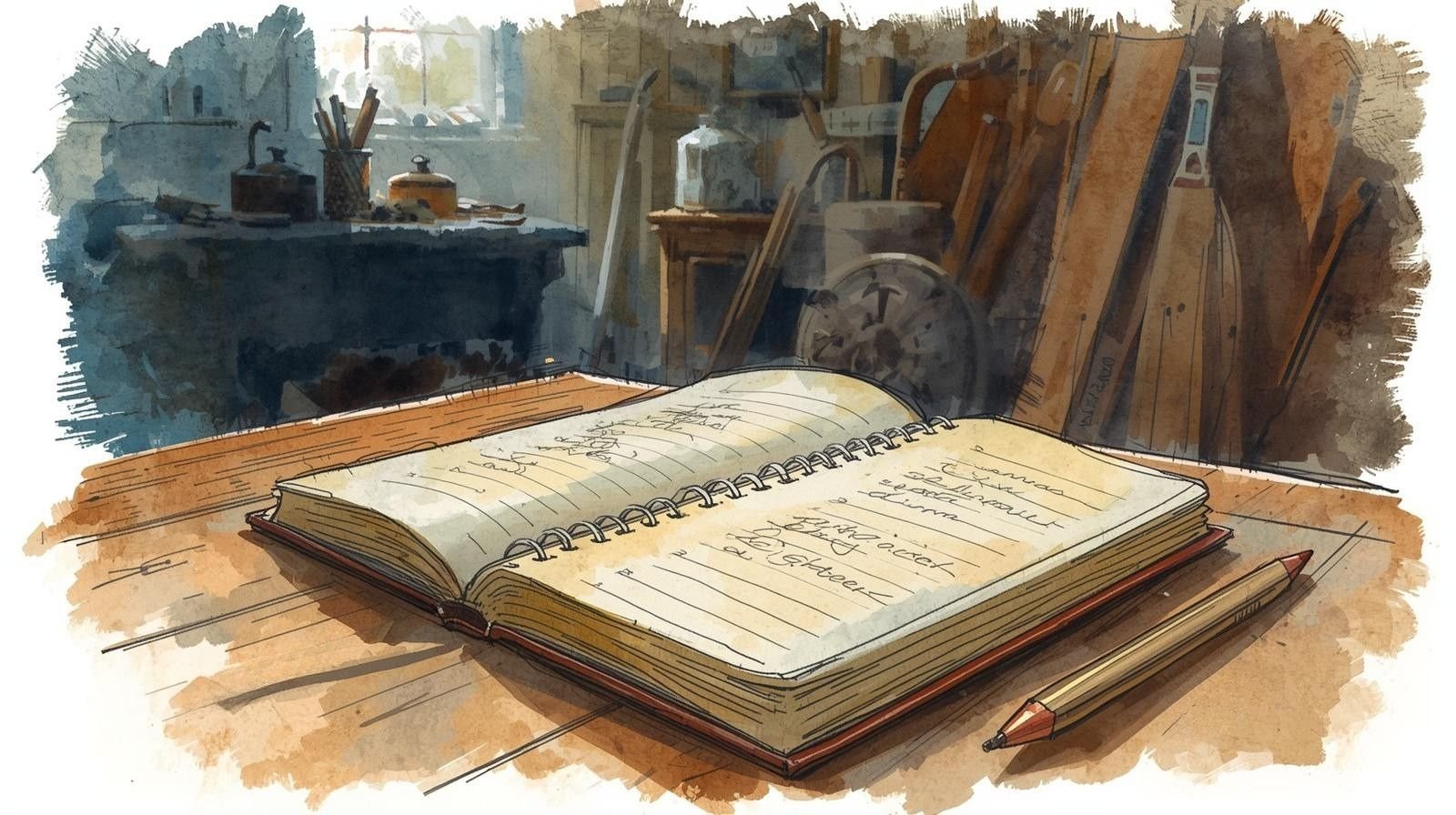
While looking for that watch, Armando found an old notebook in the workshop. It was not an elegant diary, but a cheap notebook, with his father’s shaky handwriting. His natural curiosity led him to flip through it.
There were brief, almost timid phrases:
Today Armando played the guitar. I stood listening from the doorway, so as not to disturb him. It really sounds good.
I don’t know how to tell him I’m proud of him. He’s the best in the neighborhood.
I wish I could be like my wife, who knows how to talk to Armando. I wish he knew how much I think of him.
Armando felt ashamed. Not because of what his father had done, but because of what he had failed to see. He had lived judging the surface without suspecting the depth.
That night, Armando sat down across from his father. For the first time, he didn’t look for signs or gestures. He just looked at his father, without prejudice. I read your notebook, he said.
Ramón lowered his gaze, as if he’d been caught in the act. But Armando continued, with a sincerity he’d never had before:
Forgive me. I’ve spent so long without knowing how to look.
Ramón looked up, surprised. He did not fully understand, but he opened his arms. And Armando, for the first time, let himself be embraced without analyzing, without demanding, without judging. And he realized that true love does not always shine as we imagine, but it always nourishes and protects us.
Saint Peter has reflected on the fact that we are children of a Father who has revealed himself to us through Christ. Let us note what he invites us to consider in the Second Reading:
► This is a Father who judges us according to our works. He does not remain indifferent; he does not care what we do, but rather expects us to live a fruitful life, no matter how difficult that may sometimes be. This is filial awareness, the constant remembrance of who I am, which, in turn, continually changes my behavior.
► He exhorts us to behave “with fear.” That fear is the one a sensible person feels at the possibility of missing an opportunity to do something important, to be united with a loved one. Paul reminds us that our vain way of life, our futile behavior, is inherited from our parents,” which invites us to reflect on the reality and consequences of original sin, which go beyond the story of a serpent and an apple.
► He reminds us that we are pilgrims, which implies reflecting on the fact that none of us are “at home”; therefore, we will all make mistakes, we will all lack vision of the path, and we need comfort and companionship. It is important to remember this, for the believer is a stranger in a world that elevates the ephemeral to an absolute.
At the same time, no pilgrimage lasts forever, and it has a destination for which we must prepare ourselves now.
► We have been freed from our “futile ways,” which refers not only to the sins we commit every day, but also to missed opportunities, wasted time, and the many chances we have failed to seize to serve -and thereby- to experience true happiness. It is impossible to find direction and meaning in our lives without listening to Christ’s call.
► Peter concludes precisely with what is the motto of the Idente missionaries: that our faith and our hope be placed in God.
—ooOoo—
Perhaps the most practical and solid lesson from today’s Gospel is that we find Christ in the poor, in those who need help, and whom we welcome. Without having to perform the same acts as Mother Teresa of Calcutta, we understand her words better today: We cannot say that we love Jesus only in the Eucharist. We cannot separate the Eucharist from the poor.
The two traveling disciples invited Jesus to dine with them, because “they saw something in him,” and as they shared the table, they recognized him and were transformed, renewed in their faith and confirmed in their mission. The opposite example is offered by the Master when he tells the story of the rich man who refused to welcome the poor Lazarus (Lk 16:19-31).
People often speak of the blindness of the disciples of Emmaus, but it is worth noting how, in that very dramatic moment, they did not fail to welcome the traveler who approached them and struck up a conversation with him.
The Gospel says that they were arguing, each offering his own explanation for their disappointment, searching for someone to blame—someone who had convinced them to embark on that failed endeavor. This continues to happen today with those who abandon their vocation; they have an urgent need to find someone to blame, someone responsible for the pain they experience; they need to feel like victims, never unfaithful or mediocre.
When we are disappointed, tired, or hurt, we are not always willing to listen, share, or acknowledge our suffering. We prefer to stick to our routine, which, even if it requires effort, is still comfortable. There are plenty of examples of this in the Gospel, which should convince us of how easy it is for us to remain anchored in that spiritual or worldly “comfort zone”:
* For the innkeeper who does not welcome Joseph and Mary (Lk 2:7), “there was no room for them at the inn.” Perhaps there is no ill will here, only exhaustion, routine, and a lack of sensitivity. And that lack of hospitality causes God to go unnoticed. However, at Emmaus, the disciples say: Stay with us.
* In the parable of the Good Samaritan, the priest and the Levite who pass by in Luke 10:31-32. The inability to hear another’s suffering stems from an inner confusion: they believe they are serving God by avoiding contact, when in reality they are ignoring Him.
* The rich young man who goes away sad (Mk 10:17-22) is trapped in his expectations, which apparently were not rooted in sin or laziness. Therefore, his heart is divided, and that division prevents him from opening himself to the presence of a God whom he admires but does not listen to.
When we allow ourselves to be trapped by these forces, there is no hospitality possible, neither toward God nor toward others.
In fact, we encounter the Master in the Eucharistic celebration through the Liturgy of the Word and the Eucharist. Through them, the Church nourishes poor souls with the Word and the Body of Christ. The disciples of Emmaus had the grace to share the Word and the Bread with the Risen Christ himself… and they did not miss the opportunity.
Let us not forget that good and exemplary people, such as Abraham and Sarah, did not recognize the three people they had fed with exquisite hospitality as angels. But their way of welcoming them led them to receive a very special reward: the son they had longed to have for years.
_______________________________
In the Sacred Hearts of Jesus, Mary and Joseph,
Luis CASASUS
President