Gospel according to Saint Matthew 22:15-21:
The Pharisees went off and plotted how they might entrap Jesus in speech. They sent their disciples to him, with the Herodians, saying, “Teacher, we know that you are a truthful man and that you teach the way of God in accordance with the truth. And you are not concerned with anyone’s opinion, for you do not regard a person’s status. Tell us, then, what is your opinion: Is it lawful to pay the census tax to Caesar or not?” Knowing their malice, Jesus said, “Why are you testing me, you hypocrites? Show me the coin that pays the census tax.” Then they handed him the Roman coin. He said to them, “Whose image is this and whose inscription?” They replied, “Caesar’s.” At that he said to them, “Then repay to Caesar what belongs to Caesar and to God what belongs to God.”
The Coin God Expects
Luis CASASUS President of the Idente Missionaries
Rome, October 18, 2026 | XXIX Sunday in Ordinary Time
Isa 45: 1.4-6; 1Thess 1: 1-5b; Mt 22: 15-21
The origins of taxes date back to the earliest organized civilizations. When cities, armies, temples, and public works emerged, rulers needed resources to sustain them, and thus taxes came into being. In the ancient cities of Mesopotamia, around the third millennium B.C., residents handed over part of their harvests, livestock, or labor to maintain temples, palaces, and waterworks.
In Ancient Egypt, taxes were paid mainly in grain and other agricultural products. The resources collected were used to support the pharaoh’s administration and finance major public works. Over time, tax systems became more sophisticated. In Classical Greece, taxes linked to the maintenance of the city and the funding of wars appeared; in the Roman Empire, there were taxes on land, trade, and various economic activities.
The tax mentioned in today’s Gospel was the tribute to Caesar—that is, a tax that the Jews were required to pay to the Roman Empire. The controversy was not solely economic; it was also political and religious. Many Jews considered it humiliating to pay tribute to a foreign power.
Jesus does not enter into that controversy. He knows that taxes are necessary and also that—without a doubt—there will always be rulers who will use them dishonestly and for their own benefit, that of their families, and that of their supporters.
However, he takes this opportunity to offer a concise and expressive formula for what our relationship with God should be: to give Him what belongs to Him.
But it is true that we are not even aware of everything within us that we ought to place in His hands; at other times we refuse to do so, like the wicked vinedressers in the parable, who killed the son of the vineyard owner (Mt 21:33–43).
The first case is that of a novice monk, who had this conversation with his spiritual guide:
The disciple asked: Master, what should I give to God?
The master replied: First, find out what you have managed to keep for yourself.
The disciple checked his pockets and found nothing.
Then the master pointed to his chest and said: Look there.
A somewhat simplistic interpretation of today’s Gospel would be to say that, just as we must obey tax laws, we must respect God’s Law.
And the truth is, sometimes we fail to realize how important it is to “give to God” certain aspects of our innermost selves: we offer Him certain activities—such as time for prayer, religious practices, and good deeds—but we reserve parts of our lives for ourselves.
In reality, “giving Him something” means placing it at His disposal, but we don’t fully believe that He is waiting to create a work of art—something unique—with what we offer. We are like the disciples, who erred in their calculations and judgments based on worldly standards: Five loaves and two fish for thousands of people… is nothing.
—ooOoo—
What matters most is the desire, the intention that our Father may hold in His hands the humble raw material to produce something that speaks of heaven, of His presence.
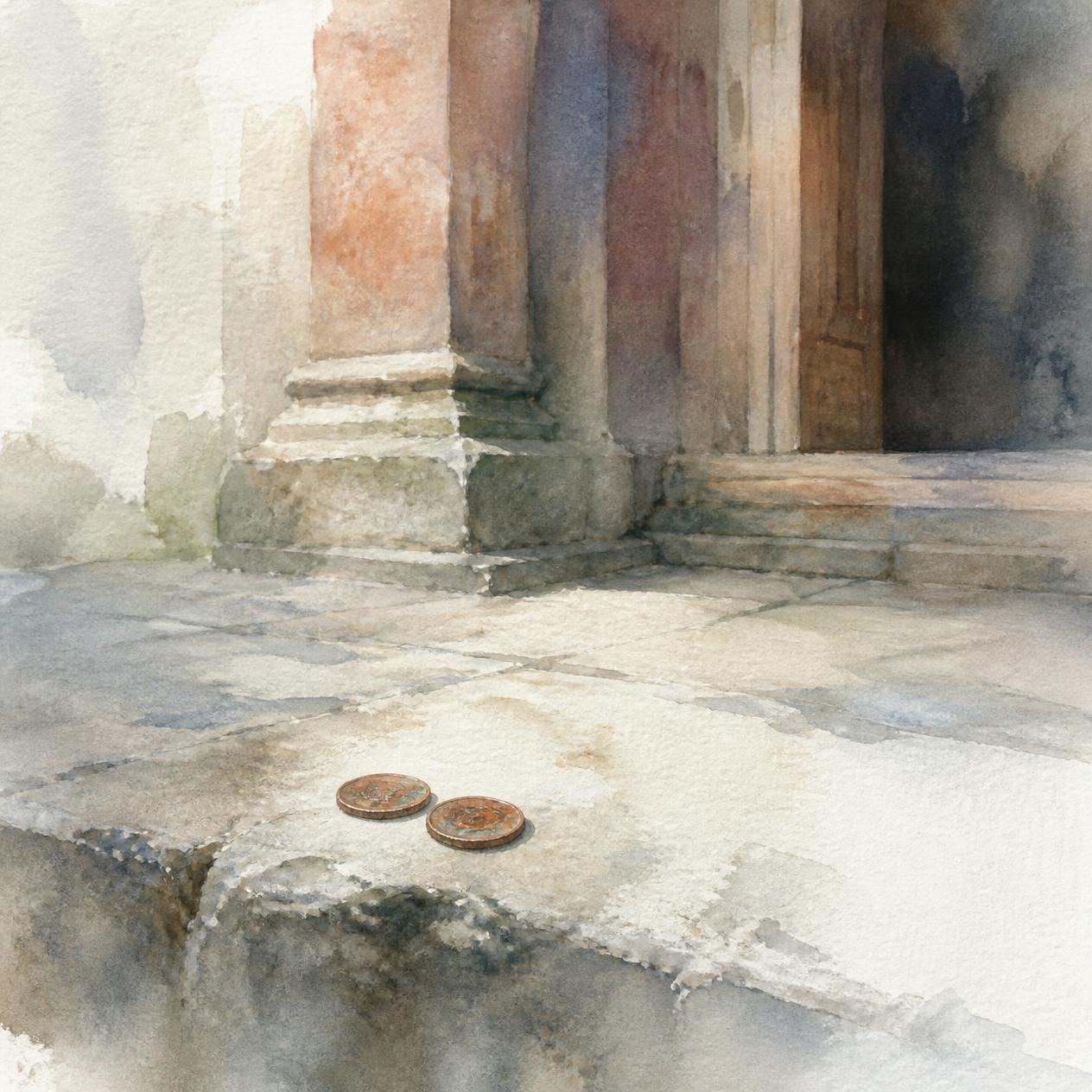
The poor widow who gave two coins (Mark 12:41–44) is an example of how God is moved by the generosity of His children and responds by making it shine like heavenly light before everyone.
In John’s account (6:1–13) of the feeding of the five thousand, a boy appears who offers his small supply. What he keeps for himself remains five loaves and two fish; what he gives to Jesus becomes food for everyone. The multiplication of the loaves shows what happens when we truly do that; what we offer to God does not disappear in his hands, but rather takes on an unexpected fruitfulness.
In Luke 5, Jesus asks for Peter’s boat so he can preach. Peter might have thought: This is my tool of the trade, and now I have to mend the nets. Yet he lends it to him, and that very boat, offered to Jesus, becomes a pulpit, a place of encounter with the Word, and ultimately the setting for a miraculous catch. First, Peter offers a humble boat, and then he discovers that God gives him back a sublime vocation.
But perhaps what most closely mirrors the lesson of today’s Gospel is the offering of those who feel incapable of changing, of abandoning their habits, their mediocrity, and their pride—and yet are willing to do so in the name of Christ. Once again, Peter’s words: In your name I will cast the nets (Lk 5:5) perfectly reflect this form of self-surrender, which responds to the desire expressed by Jesus himself: I desire mercy, not sacrifice (Mt 9:13), echoing the words suggested by Yahweh to the prophet Hosea (6:6). That is what God (not just my neighbor!) expects to receive from me, because it is the most unmistakable and powerful sign of his presence in my humble life.
Of course, there is a detail in the episode that Matthew recounts today which shows how Christ is concerned with nothing other than mercy: When questioned by the Pharisees and Herodians, he asks them to show him the denarius used to pay the tax. And so they do, thereby proving that Christ had no coins, nor a place to lay His head (Mt 8:20), while they had no qualms about hoarding and using coins inscribed with the name of Tiberius Caesar, son of the “divine Augustus”—which was nothing less than a form of idolatry.
Often, certain attachments, pride, the desire to control, wounds we are unwilling to let go of, and those parts of our conscience where we keep saying, “this is mine alone,” prevent us from living out forgiveness and patience toward our neighbor; instead, we substitute it with “sacrifice,” which God, in reality, abhors.
Thus, we act cruelly, like the Pharisees who became angry when they saw Jesus’ disciples eating ears of grain they had plucked from the field on the Sabbath; yet the Master, placing mercy above the Law, allowed them to satisfy their hunger. Instead of allowing Christ to board the boat, we want to continue using it as part of our comfort zone.
On many occasions, mercy shown in the name of Christ will be misunderstood, as happened during a supper when Mary poured an extremely expensive perfume on Jesus (John 12:1–8). To Judas Iscariot, it was a waste, but to Jesus, it was an expression of love that served as a lesson and example to the disciples and all the guests, remaining forever linked to the memory of the Gospel.
Likewise, when a woman known as a sinner poured a jar of alabaster perfume on Jesus’ feet as a gesture of the utmost reverence (Luke 7:36–39), Simon, the Pharisee who had hosted the meal in honor of Christ, harbored an unmerciful, judgmental thought toward the woman—and toward Christ as well.
But sooner or later, the smoke from our small acts of mercy reaches heaven.
—ooOoo—
When God created man, He said: “Let us make man in our image, after our likeness,” and He created man in His image; in the image of God, He created him (Gen 1:26–27). Just as God is not content to give us “something,” but rather it is He Himself who hopes to dwell within us—since we bear His image—we are a coin that must return to His hands. Surrendering ourselves to Him means doing everything in our power to love in His way.
It is like when a lover says to the beloved, “I am yours,” as happens in the Divine Comedy. Love for Beatrice gradually transforms the lover. Dante not only contemplates his beloved but is gradually shaped by her: his way of thinking, feeling, and perceiving reality changes under her influence. The beloved becomes the source of inner transformation. In a clear sense, the lover comes to resemble the one he loves.
Literature has continually explored this insight; by giving himself over with authentic love, the lover does not remain unchanged, but is shaped according to the one he loves. Not all mystics have been able to explain how this happens. But St. John of the Cross, in his Spiritual Canticle, recounts how the soul in love with God ultimately acquires the traits of the Beloved. Love produces a mutual likeness expressed as follows: “The beloved into the Beloved transformed.” This statement masterfully sums up the idea that perfect love leads to surrender to God, and the consequence is… becoming a true image of Him.
St. Paul, speaking today to the Thessalonians, reminds them of this reality, which we should keep in mind as we consider that we, too, have been called in the same way: When the Gospel was proclaimed among you, it was not merely words, but also the power of the Holy Spirit and deep conviction.
Pope Francis said, while commenting on today’s Gospel reading on October 22, 2017:
But above all—Jesus reminds us—you belong to God. It is He who has given you everything you are and everything you have. And therefore, day after day, we can and must live our lives in the re-cognition of this fundamental belonging of ours and in the re-cognition of our heart toward our Father, who creates each of us uniquely, irreplaceably, yet always in the image of His beloved Son, Jesus. It is a wonderful mystery.”
These words mean that we are usually asleep, numb to the reality of our existence, and that is why we must “re-cognize”—become aware once more of who we are, of what our true home is, and of our authentic destiny. Only then will we stop protecting our capricious ego and give to God what is His, through the mercy we show to those around us.
_____________________________
In the Sacred Hearts of Jesus, Mary and Joseph,
Luis CASASUS
President