Gospel according to Saint Matthew 14,13-21:
On hearing about the death of John the Baptist, Jesus set out secretly by boat for a secluded place. But the people heard of it, and they followed him on foot from their towns. When Jesus went ashore, He saw the crowd gathered there and He had compassion on them. And He healed their sick.
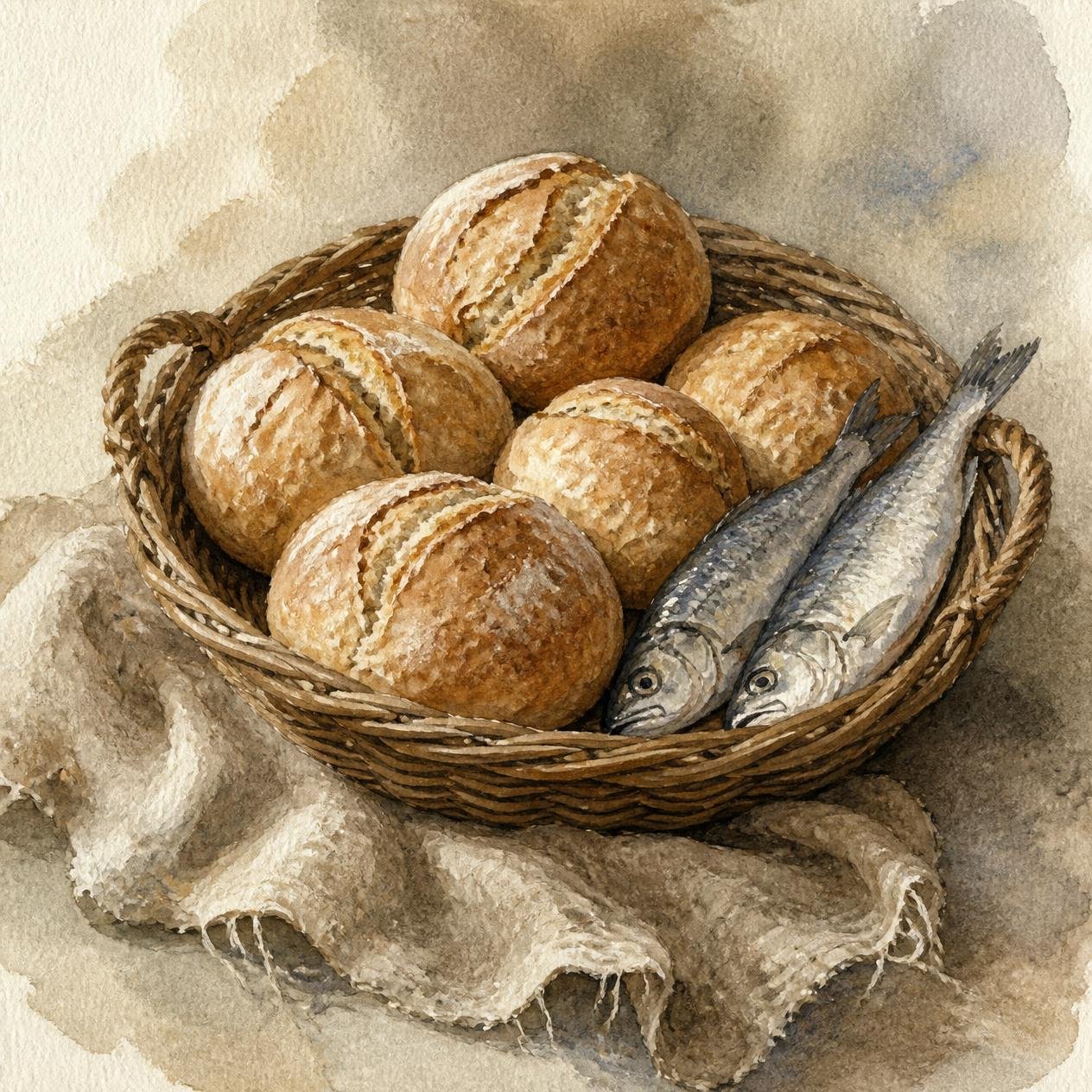
Late in the afternoon, his disciples came to him and said, «We are in a lonely place and it is now late. You should send these people away, so they can go to the villages and buy something for themselves to eat». But Jesus replied, «They do not need to go away; you give them something to eat». They answered, «We have nothing here but five loaves and two fishes». Jesus said to them, «Bring them here to me».
Then He made everyone sit down on the grass. He took the five loaves and the two fishes, raised his eyes to heaven, pronounced the blessing, broke the loaves and handed them to the disciples to distribute to the people. And they all ate, and everyone had enough; then the disciples gathered up the leftovers, filling twelve baskets. About five thousand men had eaten there besides women and children.
Bread and fish… or a beef stew?
Luis CASASUS President of the Idente Missionaries
Rome, August 02, 2026 | XVIII Sunday in Ordinary Time
Is 55: 1-3; Rom 8: 35.37-39; Mt 14: 13-21
On one occasion, someone who had studied theology—or at least claimed to have—asked me why Christ, instead of multiplying the loaves and fishes, didn’t do something more “interesting,” like serving the crowds a meat stew with plenty of onions, garlic, lentils, and cumin. According to what he said, that was part of the menu at weddings or official banquets of the time. All well washed down with wine.
The question has a touch of humor and irony, because those who ate the loaves and fish would undoubtedly return the next day to struggle for their modest, usual diet of bread, fish, and some vegetables. But it is a superficial observation, because it does not focus on Jesus’ splendid gesture, who chose to perform the miracle using the only thing his disciples could offer him at that moment.
We need not dwell on it to understand that today he continues to do the same, with you and me. Even if we are clumsy, lacking in faith, and discouraged, the Master desires that God be made visible in our smallness.
God the Father did not need to send angels to show that he cared for those people; the disciples, serving each one, were proof that Yahweh continued to accompany them in the desert and in the wilderness. In the same way, whether we are aware of it or not, we know that we are the light of the earth and the salt of the world (Mt 5:13-16). Salt transforms silently, and light represents visible and active witness. But what stands out in today’s episode is how this happens when we feel a deep sense of helplessness and turn to Christ, explicitly asking Him what we can do, sharing with Him whatever comes to mind—even if it is something clumsy, like sending people away from Him to address their nutritional needs at a supermarket.
This is also relevant to my intimate relationship with God the Father, because we see how He multiplies whatever we give Him, no matter how small it may be. I can come to Him with my clumsy prayers, my wavering faith, my limited time, and my moral life that is far from perfect. What matters is placing everything in His hands: my sins, my longings, my pain, or my joy: Father, this is all I have today, but I give it to You. It is the first act of communion; then comes doing it with my sisters and brothers, with my neighbor… as He inspires me.
—ooOoo—
In any case, the Gospel text begins with an important detail: Jesus had withdrawn to pray, to meditate, and to find some relief after learning of the death of John the Baptist. He needed to recover from the news he had received, to catch his breath before continuing, but a crowd followed him and He immediately changed His plans: “He had compassion on the crowd and healed the sick”.
It is a visible example of what He continually did: letting Himself be moved by the suffering of His neighbors. A few verses later, St. Matthew says that, once again, Jesus went up the mountain to pray alone; and when evening came, he was there by himself (Mt 14:23). And a similar situation arises; the disciples find themselves in serious trouble, because they are in the boat and are caught in a strong wind. Christ does not hesitate and goes to them, in this case walking on the water.
All of this should make us reflect on whether—personally and as a community—we are part of a “Church that goes forth,” as Pope Francis said, that is, whether we are a Christian community that leaves behind the comfort of what we know how to do, the plans we have made, rest, and seclusion, to actively go out to meet those in need and bring the message of the Gospel to the geographical and existential peripheries.
Christ did not allow himself to be overcome by the sadness that so often overwhelmed him, nor by the disappointments he suffered at the behavior of his followers. His form of active love was not shaken by anything, as today’s Second Reading mentions: Neither tribulation, nor distress, nor persecution, nor hunger, nor nakedness, nor danger, nor the sword.
Today is a particularly good day to ask myself how tribulation, distress, persecution, hunger, nakedness, danger, or the sword manifest themselves in my own life. If I do not do so, I will not be able to feel the confidence that St. Paul expresses today, even as he was fully aware of his internal and external limitations.
Many of us convince ourselves that “we’re at our limit,” that we’re giving it our all, but that’s a sign that our focus remains on the number of activities, the few hours of sleep, or the physical and mental exhaustion. All of that, as St. Paul says, cannot separate us from Christ’s way of loving. It’s not always a matter of doing more activities.
Although Jesus begins today by healing the sick, moved by the very compassion he feels, he then multiplies the loaves and the fish, surely driven by the joy of seeing how his disciples were becoming sensitive to the suffering and needs of others. This is what Affliction means in our spiritual life: the gift of sharing the pain that the Divine Persons feel for human beings. In this way, we become more and more like the Creator intended us to be: truly in His image and likeness.
One example that illustrates this transformation is that of Etty Hillesum (1914–1943), a young Dutch Jewish woman whose compassion was transformed. Her life shows how human compassion can expand until it resembles that of God.
At the beginning of her famous diaries, Etty reveals herself to be a brilliant yet wounded young woman, prone to anxiety and inner turmoil. Her compassion is selective, emotional, limited to her inner circle.
In 1941, while imprisoned in a concentration camp, she begins a journey of inner reflection and discovers within herself a presence she calls “God,” though she is not religious in the traditional sense. She writes: Inside me there is a very deep well. And God is in that well. And this discovery changes the way she looks at others; her compassion ceases to be an emotional reaction and becomes an inner mission.
She begins to see every person—Jews, soldiers, the sick, the elderly—as bearers of an inviolable dignity. This compassion no longer depends on whether the other person is kind, just, or innocent.
At the Westerbork transit camp, where she works as a social worker, Etty comforts the desperate, writes letters for those who can no longer do so, accompanies the dying, and sustains the hope of others when their own falters. She even rejects the possibility of hiding or fleeing and wants to be where the suffering is greatest, because there she feels her compassion can be most fruitful.
Many testimonies indicate that her mere presence changed the atmosphere of the barracks, calming tensions, awakening hope, and making others feel seen and loved. Her compassion did not eliminate suffering, but it transformed the experience of those around her.
—ooOoo—
In the miracle of the multiplication of the loaves and the fishes, Christ does not seek merely to eliminate pain and satisfy the needs of those around him. However urgent and overwhelming the situation of those people may be, above all, he wants to do them the greatest good: to bring them closer to his Father.
The destitute are hungry, but even those who are sated feel sad, frustrated, and alone; their satisfaction lasts only a few days, if not a few hours, then anxiety resurfaces and the inner emptiness compels them to go out again in a desperate search for other goods.
Our mercy can be manifested in a visibly determined, fearless, and strenuous way, or through a daily and spontaneous gesture, like the child who simply gave the disciples the little he had (Jn 6:9). What is essential is our intention to live it by imitating our heavenly Father. What matters is the intention, the resolve to do everything “in the name of the Father, the Son, and the Holy Spirit,” as we say when making the sign of the cross.
It is significant that the Bible does not speak of “atheists”—those who lack God. Instead, it continually mentions idolaters and, above all, the idolatry that affects everyone, both believers and those who do not identify as such. Human beings left to their own devices, who ignore or despise the divine voice and the capacity to do good according to Him, become idolaters; they are slaves to their most basic instincts, even if they perform some good deeds.
In his book Conformity to the Will of God, the Founder of the Redemptorists, St. Alphonsus Maria de Liguori, writes:
A man has two servants. One works tirelessly all day, but as he pleases; the other, perhaps, works less, but does what he is commanded. The latter, of course, will win his master’s favor; the other, will not. (…) For to rebel is like the sin of witchcraft; and to refuse to obey, like the crime of idolatry. The man who follows his own will independently of God’s is guilty of a kind of idolatry. Instead of worshiping God’s will, he, in a certain sense, worships his own.
As he prepares to perform the miracle of the multiplication of the loaves and the fishes, Christ shows us his deep desire to do everything according to the Father’s style, taste, and preferences. That is why Matthew says that Jesus took the five loaves and the two fish, raised his eyes to heaven, pronounced the blessing, broke the loaves, and gave them to his disciples to distribute.
More than a story, it is a whole program for life.
_____________________________
In the Sacred Hearts of Jesus, Mary and Joseph,
Luis CASASUS
President