Gospel according to Saint Mark 13:33-37:
Jesus said to his disciples: “Be watchful! Be alert! You do not know when the time will come. It is like a man traveling abroad. He leaves home and places his servants in charge, each with his own work, and orders the gatekeeper to be on the watch.
Watch, therefore; you do not know when the lord of the house is coming, whether in the evening, or at midnight, or at cockcrow, or in the morning. May he not come suddenly and find you sleeping. What I say to you, I say to all: ‘Watch!’”
Stay alert, Watch!
Luis CASASUS President of the Idente Missionaries
Rome, November 29, 2026 | First Sunday of Advent
Is 63: 16c-17. 19c; 64, 2b-7; 1Cor 1: 3-9 -26.28; Mk 13: 33-37
Advent, this significant season of the liturgical year, invites us to reflect on all that hope in the coming of Christ entails. As we await his return, we also receive him every day in the Eucharist, in the sacraments, in people, and in every event. It is important to be able to recognize his constant coming, so that we may welcome him as he deserves.
Christian hope is a constant and active attitude, because we are waiting for a living person with whom we already have a relationship and whose return will take us by surprise. That is why we must prepare for his arrival, put our lives in order, and put on our best clothes.
To illustrate this proactive sense of vigilance—where watching is not about standing paralyzed, staring at the sky, but about being fully present and active in our daily duties—there is a famous Zen story about Master Hara Tanzan (1819–1892) and the tea cups.
At a Zen monastery, Master Tanzan had a young novice in his care who was responsible for tending to the temple and, in particular, for guarding an extremely old and valuable set of porcelain tableware, used only for the most important tea ceremonies. The master always repeated to him: Keep a close watch; stay alert. Do not neglect the house for even a second.
The young man, interpreting the master’s words too literally, spent his days sitting in a meditation posture in front of the porcelain cabinet. He barely blinked. His eyes were wide and his body tense, watching to make sure no intruder entered and that nothing touched the cups. He was so obsessed with “watching out” for future danger that he forgot to live in the present.
One afternoon, while the novice was engrossed in his rigid and anxious vigilance, Master Tanzan silently entered the tea room carrying a huge bucket of water to mop the floor. The floor was slippery, but the novice, absorbed in his fixation on the cabinet, did not move to help his master or wipe up the splashing droplets.
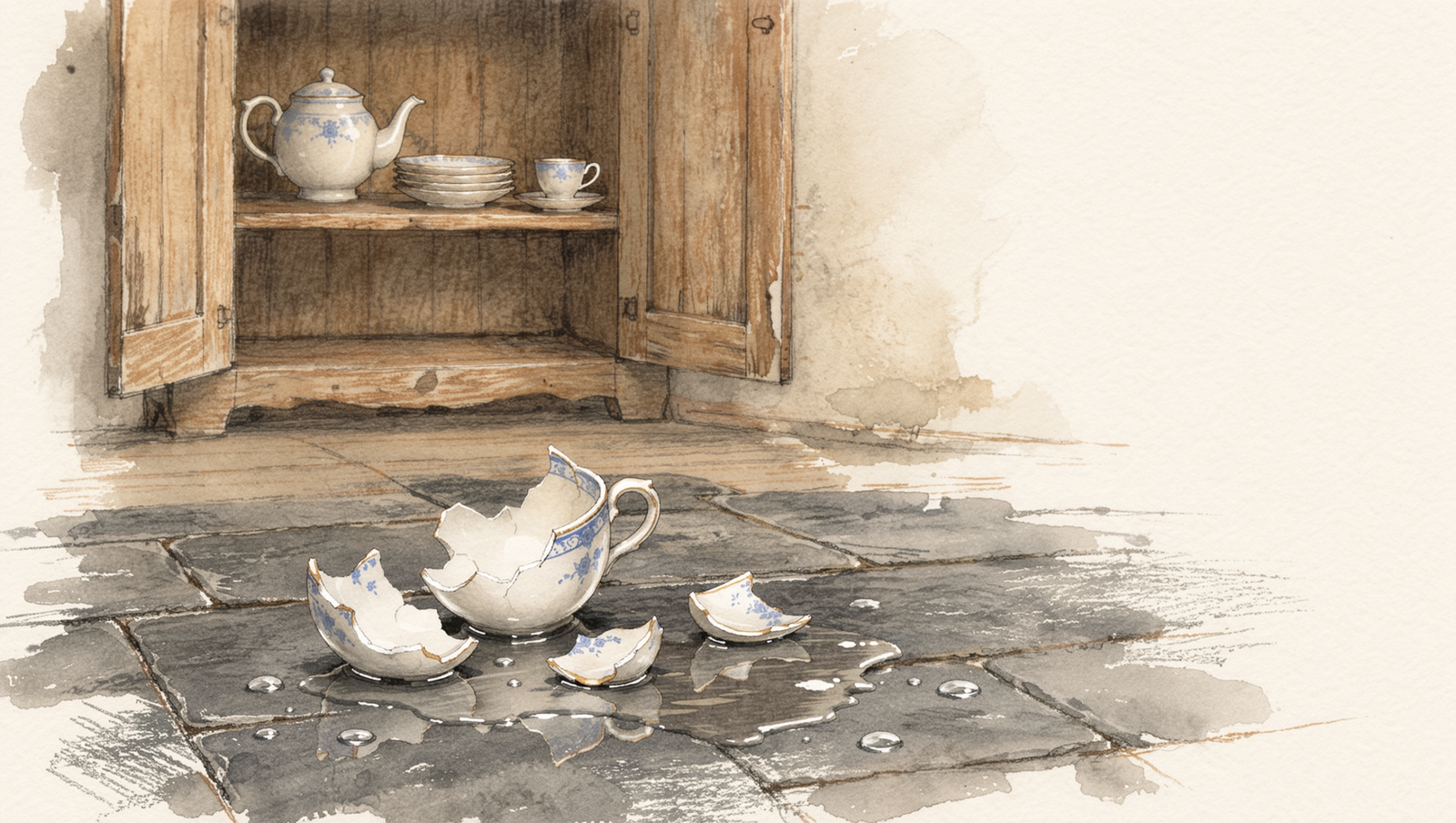
Seeing the young man’s stiffness, Tanzan approached the cabinet, took the most valuable cup from the collection, and threw it directly into the novice’s arms, without warning.
The young man, lost in his thoughts and paralyzed by surprise, reacted too late. The cup struck his stiff hands, slipped, and shattered on the stone floor.
The novice, trembling with fear and guilt, exclaimed:
Master! I have failed! I was keeping watch with all my strength—I haven’t slept all day! Why did you do that?
Tanzan, looking at the pieces on the ground, smiled with his usual compassion and said to him:
Your mistake was confusing vigilance with paralysis. You froze up worrying about tomorrow, and that’s why your hands were not ready for today. The true guardian does not tense up in anticipation of danger; he is the one who keeps his arms supple, his mind clear, and his heart open to receive whatever comes, the moment it comes. If you had truly been keeping watch, you would have been able to catch the cup in midair, or been attentive enough to help me with the water before this happened.
To be truly attentive requires having faith in the object of our attention; we must truly value and cherish it. Often, in school, students can’t stay focused because—for example—the Pythagorean Theorem or the grammatical rules of Latin don’t excite them, don’t move them… and they don’t clearly see how these things might be useful to them, how they might—in some way—change their lives. However, the Gospel teaches us today that the master of the house, before leaving, assigns a task to each one.
In some saints, this awareness of fulfilling a unique and personal mission—one that transcends all worldly measures—is very evident. Such was the case with Saint Charles Borromeo; when the plague ravaged Milan, all the nobles fled. He, as the “gatekeeper” of the local Church (Mk 13:34), stayed behind to watch over and care for his people. When asked what he would do if he knew he were about to die immediately while playing chess, he replied: I would continue playing, because I began this game for the glory of God, and I would wish to finish it for the same reason.
It is clear that he was a good disciple of Don Bosco. This holy Founder organized a spiritual practice at the Oratory called the Exercise of the Good Death (now also known as a monthly retreat or day of review). It is interesting to recall this today, when the Gospel speaks to us of our final encounter with Christ.
Far from being a somber occasion, it was a day dedicated to reflection and the purification of the heart, during which the young people went to confession and received Holy Communion as if it were the last day of their lives. They prayed to ask God for the grace of a holy death and made a profound examination of conscience to correct bad habits before they took root. This practice transformed the preparation for death into a serene and natural habit, characteristic of those who await someone who has always loved us.
The followers of Jesus know that life has meaning—that is, it has a “happy ending.” That is why they live in the confidence that, despite the sad appearances that characterize our world, everything will end well in God’s hands.
For Benedict XVI, the relationship between faith and hope is so intimate and close that the two concepts become practically interchangeable. In his second encyclical, Spe salvi (Saved in Hope), he thoroughly explores this connection, drawing on biblical roots and Christian theology, and categorically affirms that “faith is hope” (Spe salvi, n. 2). This helps us understand why our Founder, Fernando Rielo, has given us, the Idente missionaries, the motto: Believe and Hope.
Benedict XVI contrasts the great Christian hope (which springs from faith in God) with the world’s small hopes (professional success, wealth, or technical and political progress). Human hopes may be good and positive, but they are always limited and fragile. Only the “great hope”—which arises from knowing that we are loved by God in an absolute way—is capable of sustaining human beings when all other earthly certainties fail.
We can say with clarity that faith acts as the foundation (or substance) upon which hope rests. By already possessing that seed of future reality in the present, hope becomes real and clear, not a mere illusion. And furthermore, returning to Benedict XVI: Whoever has hope lives differently; they have been given a new life.
—ooOoo–
It is moving to see the trust and tenderness with which Isaiah addresses God today, almost holding Him “accountable” for our unfaithfulness:
Why, Lord, have you allowed us to stray from your commandments and let our hearts harden to the point of not fearing you? But this is so that we may finally place ourselves at the disposal of the One who loves us without measure and is shaping our souls:
Yet, Lord, you are our Father; we are the clay, and you are the potter; we are all the work of your hands.
And Saint Paul, in the same vein, marvels at how the Word and his own testimony help those who are beginning to draw near to God to grow, certain that He gives us the gift of perseverance—a gift that so many despise and will continue to despise out of sheer laziness or selfishness:
I continually give thanks to my God for the divine gifts He has bestowed upon you through Christ Jesus, for through Him He has enriched you abundantly in every way concerning the word and knowledge; because the testimony we bear of Christ has been confirmed in you to such an extent that you lack no gift—you who are waiting for the revelation of our Lord Jesus Christ. He will keep you blameless until the end, until the day of his coming. It is God who has called you into fellowship with his Son Jesus Christ, and God is faithful.
As we begin this season of Advent, today is a good time to reflect on what the master in the parable expected of his servants: meticulous care for the house—which, above all, has to do with peace and the care we must show to those who live in the house.
Returning to the story of Master Tanzan, what matters most is helping those who are carrying a burden; forgiving; building peace in the hearts of others… and that is far more essential than taking care of precious porcelain vases, getting little sleep, or engaging in many important activities. For us, privileged servants of the Church, the most terrible sin is often the sin of omission: remaining “asleep” in the face of our neighbor’s needs and the proclamation of the Gospel.
Staying vigilant is possible if we realize that our time in this world is a continuous encounter with Christ and a constant letting go of what does not come from Him, always with a hopeful gaze fixed on what we profess (with conviction?) in the Creed: We await the resurrection of the dead and the life of the world to come.
The next time we’re in the Arrivals Hall of a train station or an airport, let’s try to let that atmosphere inspire us:
There’s a tension filled with anticipation and joy. People walk quickly, craning their necks to see over the crowd and holding up signs or flowers.
There are outstretched arms, broad smiles, shining eyes, and tears of happiness.
They know that the embrace of their reunion will be deep and tight. It instantly erases the time and distance of the past, as well as any delays from the scheduled timetable. The focus is on the immediate present and the shared future that begins in that very second. Likewise, every time we receive the Eucharist, pray in silence, or ask for forgiveness, it marks the beginning of a story.
_____________________________
In the Sacred Hearts of Jesus, Mary and Joseph,
Luis CASASUS
President